What to Know About Kitchen Countertop Height for Your Chicago Remodel
Most homeowners do not think about countertop height until they are standing in a kitchen that does not quite work. Perhaps chopping vegetables feels awkward, or a tall family member is hunching over the sink every morning. The truth is that countertop height is one of the most functional decisions in any kitchen remodel. It is one that deserves careful thought before a single cabinet is installed.
At Areté Renovators, we work with homeowners throughout Chicago, from Lakeview and Lincoln Park to the Gold Coast and River North. Our designers create kitchens that are as comfortable to live in as they are beautiful to look at. Getting countertop height right is a foundational part of that process.
The Standard Height and Why It Is Not Always Right
Where the 36-Inch Standard Comes From
The standard kitchen countertop height of 36 inches was established decades ago based on the average height of an American adult. It assumes a person around 5’8″ to 5’10” and positions the work surface roughly 4 to 6 inches below the elbow. Ergonomists generally consider this the optimal range for sustained tasks like chopping, mixing, and washing dishes.
For households that fit that profile, 36 inches works well. But for everyone else, it can be a source of daily discomfort that a good remodel can and should address. This includes taller homeowners, shorter homeowners, households with a wide range of heights, or anyone with back issues.
What Happens When the Height Is Wrong
Too low and you are rounding your back and hunching your shoulders every time you prep a meal. Too high and you are working with raised elbows, which causes its own fatigue over time. In kitchens used heavily for cooking, the wrong counter height does not just feel off. It accumulates into real physical strain. We hear this from clients regularly during design consultations, often years after a previous remodel that nobody thought to personalize.
Custom Counter Heights and What the Options Look Like
For Taller Homeowners
If the primary cooks in a household are 6 feet tall or taller, a countertop height of 38 to 42 inches is often more comfortable than the standard 36. The calculation is straightforward. You measure elbow height while standing naturally and subtract 4 to 6 inches. That is your optimal work surface height. Many of our kitchen remodeling Chicago clients in this range are surprised by how much a 2-inch adjustment changes the experience of cooking.
Lower Surfaces for Baking and Pastry Work
A dedicated baking station or pastry counter is typically set at 32 to 34 inches. This is lower than the standard to allow downward pressure for kneading dough and rolling pastry without straining the wrists or shoulders. If you bake seriously, this is one of the highest-value customizations we can build into a kitchen remodel. It does not require a large footprint. A single run of lower cabinetry or a section of island at a different height achieves the effect.
ADA-Compliant and Accessible Heights
For homeowners planning for long-term accessibility, countertop heights between 28 and 34 inches provide a comfortable and code-compliant working surface. This is also important for households that include someone using a wheelchair or mobility aid. At Areté, we incorporate accessible design principles into kitchen remodels across Chicago. We see it as part of the initial design conversation, not an afterthought.
Island Height vs Perimeter Countertop Height
Two Surfaces, Two Jobs
The kitchen island and the perimeter countertops do not necessarily need to be at the same height. In many cases, they should not be. A perimeter counter optimized for cooking tasks like chopping, stirring, and washing may sit at a different height than an island that also serves as a breakfast bar or casual dining surface.
Bar Height and Counter Height Islands
Islands designed primarily for seating typically sit at either counter height (36 inches, paired with standard counter stools) or bar height (42 inches, paired with bar stools). The distinction matters not just for comfort but for how the island reads visually in the space. A bar-height island creates a natural visual separation between the kitchen and the living area. This works beautifully in open-concept Chicago homes where defined zones are desirable without physical walls.
Mixing Heights Intentionally
Some of the most functional kitchens we design in Chicago incorporate two or three distinct surface heights. This might include a standard perimeter for everyday cooking, a lower prep or baking section, and a bar-height island for casual seating. Done well, this layering adds both function and visual interest to the kitchen. The key is designing the transitions so the variation feels intentional rather than incidental.
How Countertop Thickness and Material Affect the Height Equation
Thickness Is Part of the Calculation
When we talk about countertop height, we are always talking about the finished, installed surface, not just the cabinet height beneath it. That distinction matters because countertop materials vary significantly in thickness. Each adds differently to the base cabinet height.
- Standard laminate and engineered stone countertops typically run about ¾ inch thick.
- Quartz and quartzite slabs commonly range from 1¼ to 1½ inches.
- Natural stone like granite and marble can run thicker still, particularly with a mitered or stacked edge detail.
These differences are meaningful. A thick-edged natural stone slab on a 34½-inch base cabinet can bring the finished surface to 36 inches or beyond, depending on the profile.
Full-Slab Installations
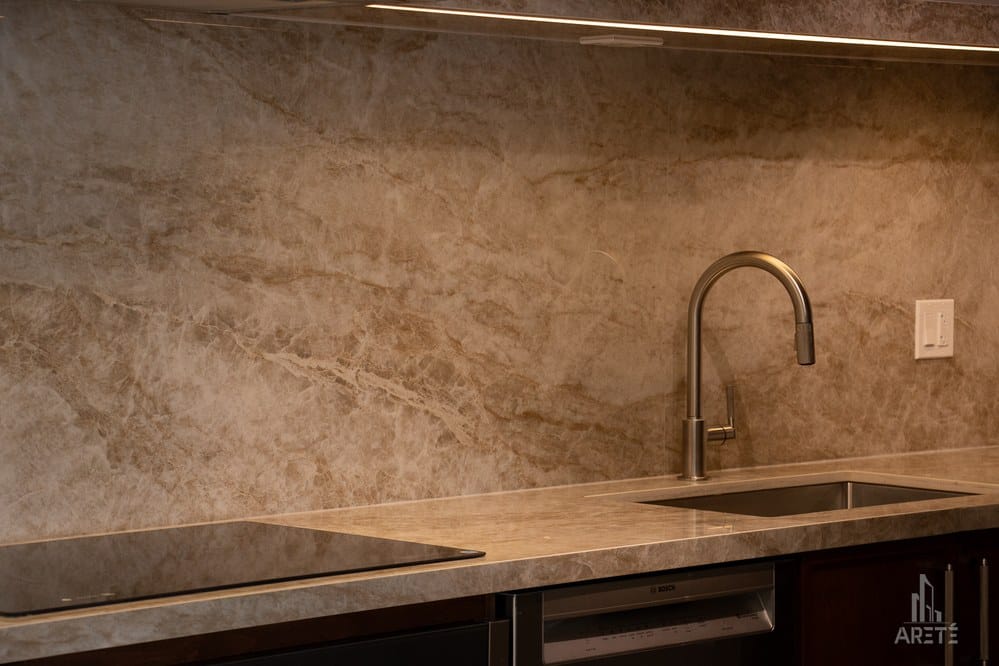
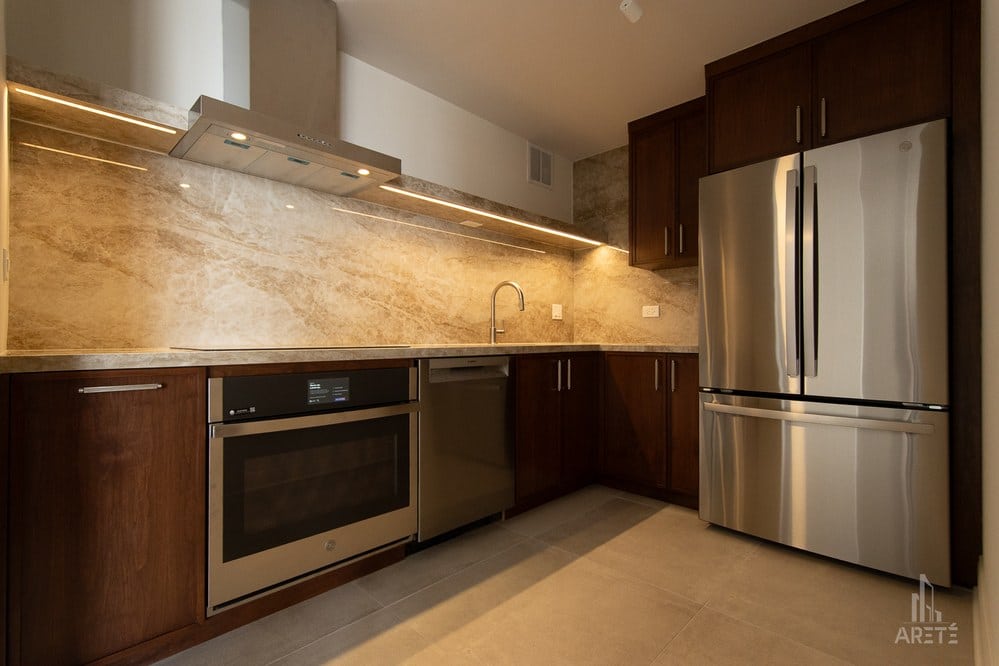
One of the most popular choices in luxury Chicago kitchen remodels right now is the full-slab installation. This involves running the same stone material continuously from the countertop up the wall as a backsplash. Beyond the visual impact, full-slab installations eliminate the grout lines that can collect debris along the backsplash. They create a seamless surface that reads as a single architectural element. When this material has strong movement and veining, as quartzite and certain porcelain slabs do, the result is genuinely striking.
At Areté, we work closely with material vendors throughout the Chicago area. Our professionals can help clients select slabs in person before committing, because no two slabs are identical. The movement and tone of the specific piece matter enormously in the finished space.
Planning Countertop Heights in a Chicago Kitchen Remodel
Start With the People, Not the Standard
The most important thing we ask clients during the kitchen design process is who cooks, how often, and what they cook. A household with one primary cook who bakes every weekend has different ergonomic needs than a household where multiple people are using the kitchen simultaneously for different tasks. These conversations shape everything from cabinet height to island configuration to the placement of appliances.
Older Chicago Homes Add a Layer of Detail
Chicago’s bungalows, greystones, and vintage two-flats often have floor levels that vary subtly from room to room. This can be a consequence of settling, previous renovations, or original construction practices. Before any cabinet installation, we take precise measurements throughout the kitchen. This ensures finished counter heights are consistent and level regardless of what the subfloor is doing beneath them. This step is easy to overlook and expensive to correct after the fact.
Permits and Process
Any kitchen remodel in Chicago that involves moving plumbing requires a City of Chicago building permit. This includes sink relocations that often accompany countertop replacements. Our team handles all permit applications and inspections as part of the project scope, so the process is seamless for our clients.
Contact Arete’ Renovators To Discuss Your Chicago Kitchen Remodel
Ready to plan your kitchen remodel in Chicago? Call us at 773.683.3033 or contact us to start the conversation. We would love to help you design a kitchen that works as well as it looks.
We offer two convenient Chicago locations:
155 N Harbor Dr, Unit 1C8A-W
Chicago, IL 60601
3821 W Montrose Avenue
Chicago, IL 60618
Photographer: Grace Juracka
Author: Amari Gamble
Date: April 24, 2026