Opening Up Your Chicago High Rise Floor Plan
If you have ever stood in your high-rise kitchen and wished you could see the living room, you are not alone. It is one of the most common things we hear from Chicago condo owners. The bones of the unit are great, and the views are unbeatable, but the layout feels chopped up and closed off from the light and space that is right on the other side of the wall. The good news is that opening up a high-rise floor plan is very possible, and when done right, it transforms the way a unit lives.
At Areté Renovators, we have helped Gold Coast, Streeterville, River North, and Lincoln Park condo owners reimagine their layouts from the inside out. Removing a wall in a high-rise is not the same as doing it in a house. There are building-specific factors, condo association requirements, and structural realities that shape how the project goes. But none of those things make it impossible. Our professionals want to show you what you need to know before you start planning.
Understanding Wall Removal in a High-Rise Condo
It rarely means just knocking down drywall. In a high-rise condo, walls can contain mechanical chases for HVAC, plumbing, or electrical, structural columns, or load-bearing elements that are part of the building’s engineered system. Before any demolition happens, we do a thorough assessment of the wall in question. We look at what’s running through it, what it’s connected to, and whether any of that limits what can be changed.
Most condo walls are not load-bearing in the traditional sense, because high-rise buildings typically transfer loads through concrete columns and the building’s core, not through interior partition walls. That is actually good news. It means many of the walls that feel like they are “in the way” are partition walls. They are non-structural, removable, and replaceable with an open span or a partial soffit if mechanical elements need to be rerouted.
The caveat is what is inside the wall. A kitchen wall that separates the cooking space from the living room often contains a chase with exhaust ductwork, electrical runs, or gas lines. We can relocate those elements, as that is a normal part of this kind of condo renovation. But it adds scope and affects the budget, so we always identify it upfront rather than discovering it mid-demo.
The Condo Board and Building Approval Process in Chicago
You will need approval before anything gets touched. Chicago high-rise buildings have their own sets of rules, and most condo associations require a formal renovation application before any structural or mechanical work begins. That application typically includes architectural drawings or scope documents, a licensed contractor’s insurance certificates, and sometimes a structural engineer’s letter confirming that the work will not affect shared building systems.
We handle this process with you. Areté has worked across buildings in the Gold Coast, Streeterville, Lakeview, Lincoln Park, and River North corridors, and we are familiar with the documentation most Chicago associations ask for. Our team will prepare what is needed, coordinate with your building’s management, and make sure approvals are in hand before work starts. Getting this right upfront is what keeps a project on schedule. Surprises at the permit or board stage are almost always avoidable.
City permits are also required for any work that involves moving or removing structural elements, relocating mechanical systems, or altering electrical. The City of Chicago building department issues these permits, and all work done under them is subject to inspection. We manage the permit process from application through final sign-off.
The Benefits of an Open Concept High Rise Layout
The transformation is usually more dramatic than people expect. In a typical Chicago high-rise condo, like a two-bedroom unit built in the 1980s or 1990s, the kitchen is a closed galley separated from the living space by a full-height wall. Removing or partially opening that wall does several things at once. It brings natural light from the living room windows into the kitchen, it creates sightlines to the view, and it makes the combined living-and-cooking space feel dramatically larger without adding a single square foot.
Open-concept layouts also change how entertaining works. Instead of disappearing into a separate kitchen while guests sit in the living room, the cook becomes part of the conversation. An island or peninsula can serve as the dividing element between kitchen and living functions. It defines the space without closing it off, and it adds prep surface, seating, and storage in one piece.
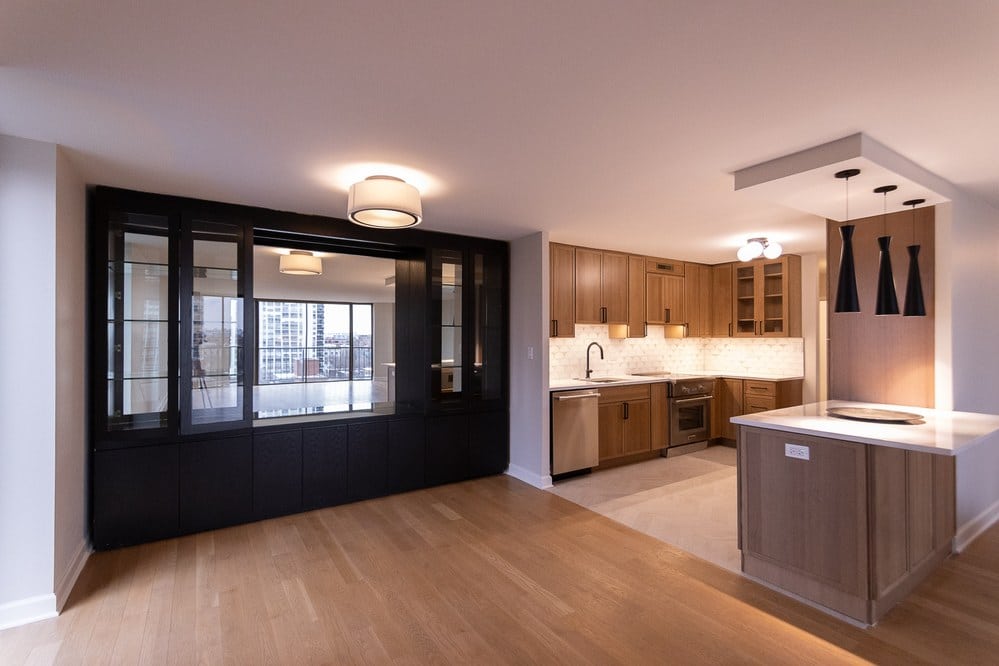
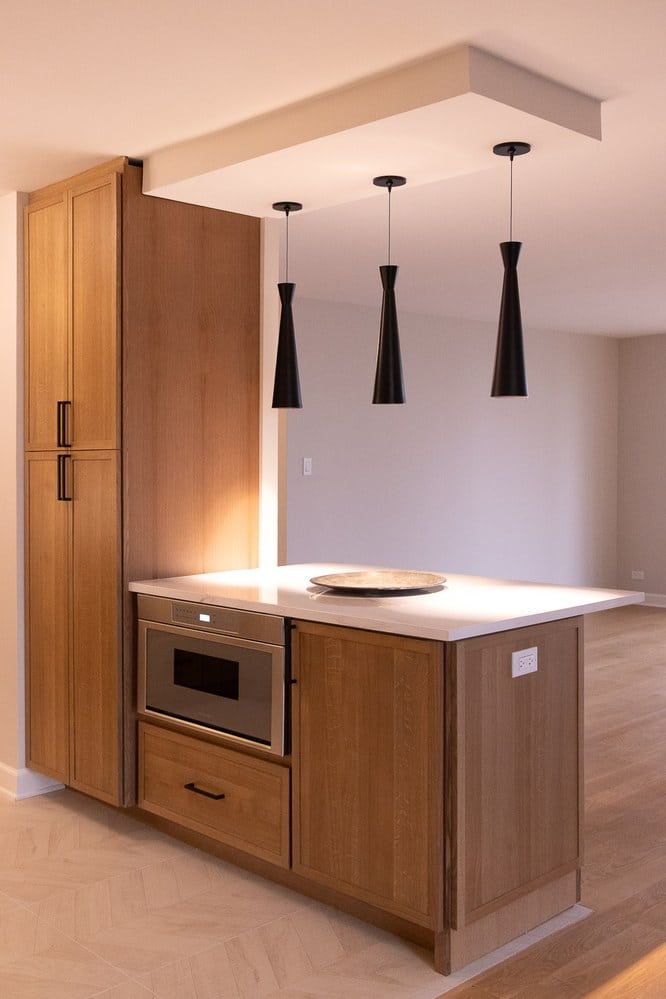
The finishes become part of the living room. This is something people do not always think about until the wall is gone. Once the kitchen is visible from the main living space, everything in it, including the cabinets, the countertops, the hardware, and the backsplash, reads as part of the overall interior. In the renovation shown here, the white oak cabinetry, quartz countertops, and matte black pendant lights carry through visually into the open living space. The custom black built-in display cabinet on the living room wall anchors the other side of the room, creating a cohesive look across the full open plan.
Design Considerations for Open Concept Living
Flooring continuity matters more than almost anything else. When a wall comes down, and two spaces become one, a single consistent flooring material running through both areas is what makes the space read as unified and intentional. In a high-rise setting, engineered hardwood, large-format stone-look tile, and luxury vinyl plank are all popular choices. They handle the building’s humidity swings, satisfy most condo associations’ sound-transmission requirements, and look polished in an open layout.
Lighting has to do more work. A closed kitchen can get away with a single overhead fixture. An open-concept space needs to handle multiple functions, such as ambient light for the living area, task lighting for the prep surface, and accent lighting over the island. Recessed cans, under-cabinet strips, and pendant fixtures over the island are a common layering strategy. The pendants in particular become a visual statement piece in an open plan where they are visible from across the room.
Storage has to be planned more deliberately. One of the tradeoffs of opening a kitchen is losing some wall cabinet space. We work with clients to maximize what remains. We can use taller upper cabinets, deeper lower cabinets, integrated pantry towers, and island storage. This way, the functional capacity of the kitchen is not sacrificed in exchange for the visual openness. In most cases, a well-planned open kitchen ends up with as much or more usable storage than the closed layout it replaced.
Cost to Remove a Wall in a Chicago High Rise
A wall-opening renovation in a Chicago high-rise typically runs between $60,000 and $120,000+. The final cost depends on the complexity of what is inside the wall, the extent of mechanical relocation required, the scope of finishes, and any millwork or built-ins that are part of the project. That range reflects real projects. We give clients detailed, line-item proposals before anything starts, so there are no surprises.
Timeline for a High Rise Condo Renovation
The timeline is typically 10 to 16 weeks from permit approval to final walkthrough. The total time depends on the project scope. Condo board approval can add two to six weeks before that, depending on your building’s review calendar. This is why we recommend starting the process earlier than it feels necessary. High-rise renovations also require coordinating building access, elevator reservations, and delivery windows. We manage all of these details, but they do affect scheduling.
The Permanent Result of a New Floor Plan with Areté
A layout change is not a refresh you will want to redo in five years. It is a structural and spatial decision that changes how the unit lives, how it photographs, and what it is worth. For most of our clients, opening a high-rise floor plan is the single renovation that makes the biggest difference in how they experience their home every single day.
If you are thinking about opening up your Chicago high-rise condo, we would love to look at what is possible in your space. Call us at 773.683.3033 or contact us to schedule a consultation.
We offer two convenient Chicago locations:
155 N Harbor Dr, Unit 1C8A-W
Chicago, IL 60601
3821 W Montrose Avenue
Chicago, IL 60618
Photographer: Grace Juracka
Author: Amari Gamble
Date: April 24, 2026