Chicago Kitchen Cabinet Colors That Are Aging Your Home in 2026
Few things date a kitchen faster than the wrong cabinet color. You can swap countertops, change hardware on a Saturday, and even take down a backsplash without too much drama. But your cabinets cover roughly 40% of the visual surface area in a typical kitchen. Once they read as out of style, the entire space goes with them.
If you’re thinking about a kitchen remodel in Chicago, whether you’re in a Lincoln Park condo, a Lakeview greystone, or a Ravenswood Victorian, knowing which cabinet colors are aging your home is just as important as knowing which colors are trending. The goal is not to chase whatever is popular on Instagram. It is to make a choice that still looks intentional, calm, and current for years to come.
Below, our designers at Areté will walk you through the cabinet colors that now feel dated, why they fell out of favor, and what Chicago homeowners are choosing instead.
Why Cabinet Color Matters More Than You Think
Cabinet color does three things at once. It sets the temperature of the room, it dates or modernizes your home, and it directly affects resale value. Industry surveys consistently find that kitchens painted in the wrong shade can lower a home’s perceived value by thousands of dollars, even when everything else is well-executed.
The cabinet colors below are not “bad.” Many of them were beautiful when they were new. But trends move, materials age, and what reads as luxury in one decade reads as builder-grade in the next.
7 Cabinet Colors That Now Read as Outdated
1. Honey Oak and Golden Oak
This is the single most common cabinet color in American kitchens. Honey oak, the warm, orange-yellow stain that ruled the 1980s and ’90s, was already on its way out by 2010. Now, it’s the color most likely to make a buyer say, “We’ll have to redo the kitchen.” The grain is busy, the orange undertones clash with most modern countertops, and the finish often yellows further with age and sun exposure.
If you have honey oak cabinets in good structural condition, refacing or repainting is almost always more affordable than replacing, and the visual upgrade is dramatic.
2. Cherry and Red-Toned Mahogany Stains
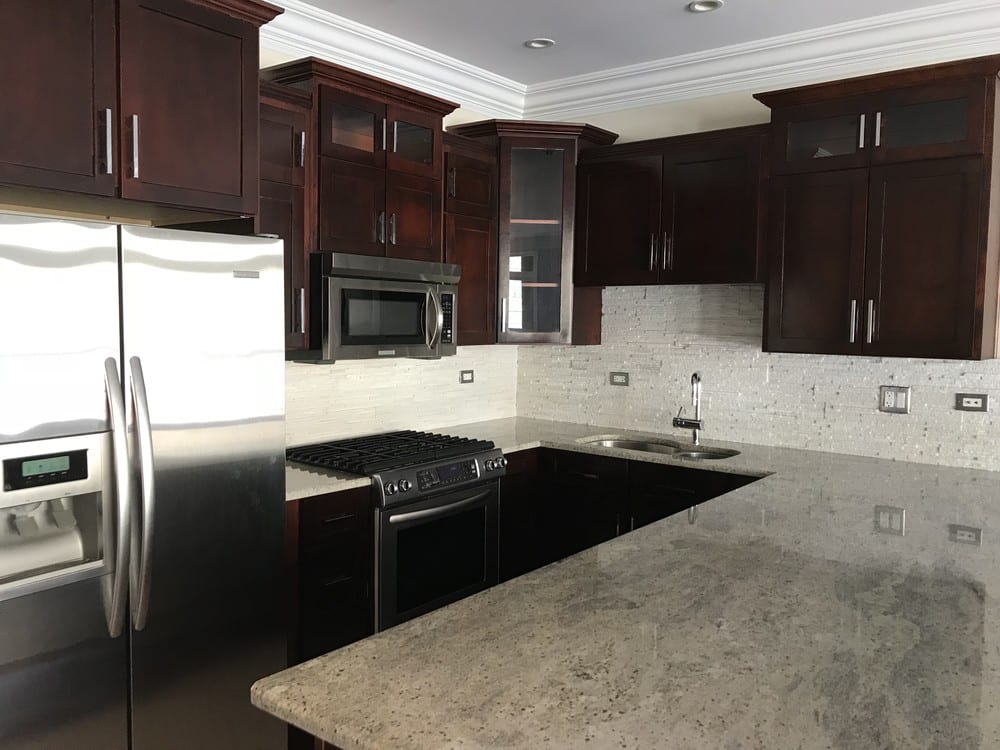
Cherry was the prestige cabinet wood of the early 2000s. It was meant to look rich, warm, and traditional. Today it reads heavy and dark, and the red undertone fights almost every current flooring and countertop choice. Cherry kitchens also tend to come with the architectural baggage of their era, such as heavy crown molding, raised-panel doors, and ornate corbels, which compounds the dated effect.
3. Tuscan Yellow, Heavy Glazes, and “Old World” Finishes
The Tuscan kitchen peaked in the early 2000s and has aged poorly. This style featured yellow-gold walls, glazed cream cabinets, faux-finished woods, and ornate scrollwork. The hand-applied glazes and intentionally distressed finishes that were sold as “artisanal” now feel busy and over-decorated. Solid, calm finishes have completely replaced this look.
4. Espresso and Near-Black Stained Wood
The espresso cabinet, a very dark, almost-black brown stain, was the 2010s answer to cherry. It dominated new construction from roughly 2008 through 2016. The problem is not black cabinets, as pure black cabinets can look striking when paired correctly. The issue is the espresso brown undertone, which reads neither warm nor cool and tends to make a kitchen feel smaller and darker.
If you love a moody kitchen, a true charcoal or near-black painted finish reads more sophisticated than a stained espresso wood.
5. Stark, Builder-Grade White
This one is controversial because white kitchens are still everywhere, and white is genuinely one of the most timeless cabinet colors. The issue is not white cabinets themselves. It is flat, cold, builder-grade white on a slab or shaker door with no contrast, warmth, or architectural detail. After more than a decade of all-white-everything, that specific style has started to feel sterile and mass-produced.
The white kitchens that are aging well are the ones with warm whites like creamy off-whites or soft alabasters. They often feature real wood accents and at least one anchor of a different material, like a wood island, a stone hood, or colored lower cabinets.
6. Almond, Cream, and Pinkish Beige
The 1990s “biscuit” or “almond” cabinet, a pinkish, peach-toned cream, has aged poorly. So have its cousins where cream cabinets are paired with cream walls and cream countertops, making the entire kitchen a beige blur. Today’s neutral kitchens lean into warm, complex undertones like mushroom, greige, or putty rather than the flat, peach-leaning cream of three decades ago.
7. Faux-Distressed and Heavily Antiqued Painted Cabinets
Painted cabinets that were intentionally roughed up, sanded back at the edges, glazed in dark wax, or “antiqued” were a major trend from roughly 2005 through 2015. They have aged into the same category as faux-finished walls and now read as costume rather than craft. Modern painted cabinets are clean and smooth, letting the color do the work.
What Chicago Homeowners Are Picking Instead
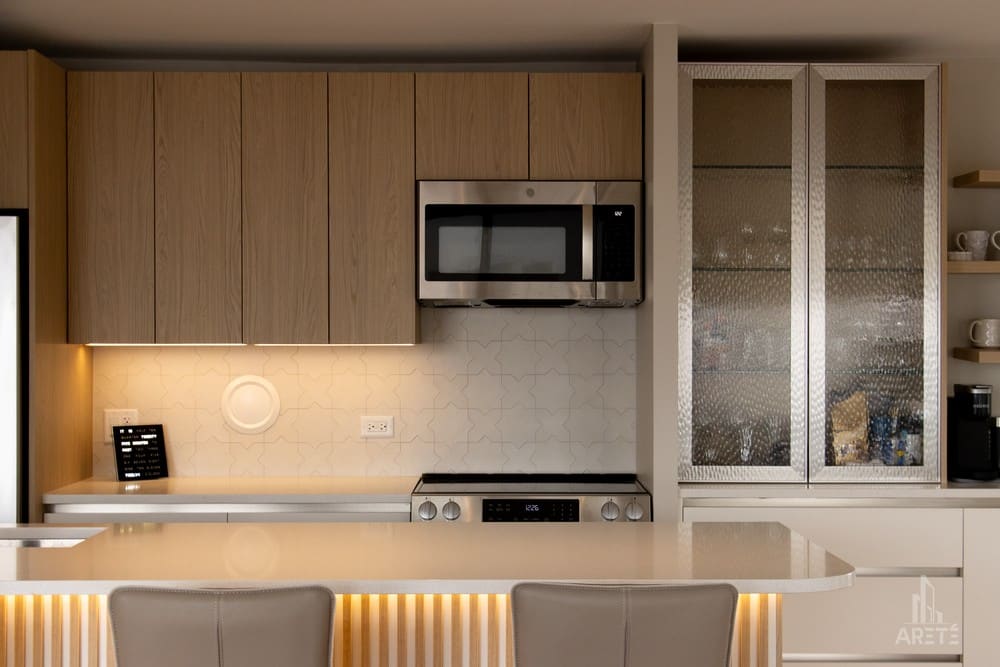
Across the kitchen remodels Areté Renovators is currently building in Chicago, four cabinet directions are dominating.
- Warm wood, especially white oak and walnut. Real wood is back, but in lighter, more honey-resistant species. Rift-cut white oak, with its straight, calm grain, has been the single most-requested cabinet wood in our shop for the last 18 months. Walnut is a close second for clients who want something darker without a stained espresso look.
- Sage and earthy greens. Soft, muted, slightly grey-green cabinets have replaced navy as the go-to colored cabinet. The undertone is herbal rather than saturated, which keeps it from looking like a fleeting trend.
- Mushroom, putty, and warm greige. When clients want neutral but not white, these warm-grey-brown tones have replaced the cool greys that dominated from 2014 to 2019. They photograph beautifully under the warm-toned lighting most Chicago condos use.
- Two-tone kitchens. Lighter perimeter cabinets with a contrasting island, such as wood-and-painted or sage-and-cream, have become a standard in the projects we are designing now. It breaks up the visual mass of a large kitchen and makes the island feel like a piece of furniture.
Should You Repaint, Reface, or Replace?
If your cabinets are structurally sound with solid wood frames and drawers, repainting or refacing is often the right move. A high-quality cabinet paint job in Chicago runs roughly $3,000 to $7,000, depending on the kitchen’s size. Refacing, which involves new doors and drawer fronts on existing boxes, ranges from $8,000 to $20,000.
A full cabinet replacement is the right choice when the boxes are particle board, the layout is not working, or you are already opening up walls for a larger renovation. A custom cabinet replacement in Chicago typically runs from $25,000 to $80,000 or more, depending on size, materials, and finish.
How to Make a Cabinet Color Choice You Will Not Regret
Our designers recommend three rules.
- Pick the color in your kitchen, not the showroom. Cabinet samples look different under various lighting conditions. Always take a finished sample home for at least 48 hours to see it in the morning, midday, and at night.
- Anchor to something permanent. Choose your cabinet color in dialogue with elements you cannot easily change, like the floor, the natural light, and the views from the kitchen window. A Logan Square home with original red oak floors needs a different cabinet color than a new Streeterville condo with floor-to-ceiling glass.
- Avoid colors at the absolute peak of their trend cycle. If you see the same exact cabinet color on every design account, you are buying it at the top. Choose a calmer, less saturated version of the trend, or pick a color that is still rising in popularity.
Frequently Asked Questions About Kitchen Cabinet Colors
What cabinet color is most timeless?
Warm white, natural wood like white oak, and soft greige have the longest historical track record. They have been in style, in some form, for the better part of a century.
Are dark cabinets out of style?
Dark cabinets are not out, but dark brown espresso cabinets are. True charcoal, deep navy, and near-black painted cabinets are very current right now.
Will white cabinets ever go out of style?
White cabinets are unlikely to ever feel as dated as honey oak. But the flat, builder-grade version of a white kitchen is starting to read as cheap. To ensure a white kitchen ages well, invest in a warm white, real wood accents, and architectural detail.
Should I match my cabinets to my floors?
No. Matching is one of the most reliable ways to date a kitchen. Choose a cabinet color that contrasts with your floor in an intentional way, either by tone (light cabinets, dark floor) or by undertone (warm wood floor, cool painted cabinet).
Ready to Update Your Chicago Kitchen?
If your cabinets are sending your kitchen back ten or twenty years, and you are ready to bring it forward, our professionals can help. Areté Renovators designs and builds custom kitchens across Chicago, from single-room cabinet refreshes to full gut renovations. We would be glad to walk through your space, look at your existing finishes, and put together a clear scope and budget for you.
Call us at 773.683.3033 or contact us to schedule your free design consultation.
We offer two convenient Chicago locations:
155 N Harbor Dr, Unit 1C8A-W
Chicago, IL 60601
3821 W Montrose Avenue
Chicago, IL 60618